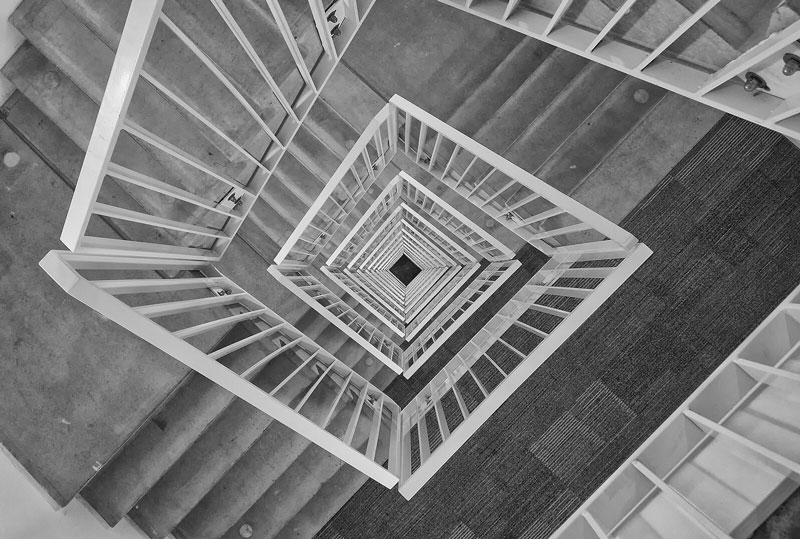
Marcie decided on Vertigo because she’d recently encountered several texts in quick succession that made extensive reference to it: Chris Marker’s time travel film told in still images, La Jetée, Terry Gilliam’s unlikely Hollywood adaptation, 12 Monkeys, and a story by Bennett Sims called “White Dialogues” about an embittered academic seething in an auditorium during a lecture being given by the hot new thing in Hitchcock studies. The coincidence made her feel involved with the film, and vice versa, in a way that evades more specific description. Courses are prepped and dishes can soak. Her eldest is kneeling on concrete at the nearest grotto, the Twins are influencing their follower(s), and Lyle is in his room obsessing over St. Patrick’s Day—despite it being August. She takes a sip of malbec as the opening credits go red, picks up her needles and imagines knitting a spiral.
The iconic rooftop chase. Somehow she remembers Jimmy Stewart’s character being chased, not doing the chasing. The vertigo effect achieved with dolly zoom. Oh shit—somehow she forgot the cop falling from the roof.
Windows looking out on San Francisco from Kim Novak’s apartment—no, that’s not Kim Novak. The set reminds her of Rear Window, along with the presence of a leg-injured Stewart. Was a woman designing brassieres allowed to be alone in a room with a man back then? Talk about their love lives?
The prototype bra works on the principle of the cantilever bridge. Scottie expresses interest. An aircraft engineer down on the peninsula designed it.
In the next scene, a shipbuilding tycoon in a mahogany office wants Scottie to follow his wife.
“Scottie, do you believe that someone out of the past, someone dead, can enter and take possession of a living being?” Scottie does not. “If I told you that I believed this has happened to my wife, what would you say?” Skepticism intensifies. “She’ll be talking to me about something. Suddenly, the words fade into silence. A cloud comes into her eyes, and they go blank. She’s somewhere else, away from me, someone I don’t know. You call her—she doesn’t even hear me. Then, with a long sigh, she’s back.”
Marcie realizes she’s never seen this film.
And it’s at this moment that Keith approaches, puts his hand not on her shoulder but on the back of the couch, says “Vertigo? Haven’t you seen this before?”
Her husband knows Marcie dislikes repeat viewings of movies, rereadings of books. She’s not wired that way. We only have so much time on this planet. It’s why she initially resisted having a second through fourth child. Repeat viewings.
“Hello?”
Keith’s been raising a family with and sleeping next to someone he thought had seen Vertigo. Last year, Marcie confidently taught a class on the Bennett Sims story.
“And she wanders,” the shipbuilder is elaborating. “God knows where she wanders. I followed her one day, watched her coming out of the apartment, someone I didn’t know. She even walked a different way. Got into her car and drove off to Golden Gate Park. Five miles.”
“Marcie?”
She looks up at Keith. “It’s just such a classic,” she says.
*
Marcie climbs the twelve-foot ladder for the hundred twelfth time today, hooking the ropey off-white yarn around one of two hundred hooks screwed into the colonnade’s molding, pulling it taught before dropping the ball of yarn to the floor, causing her last few passes to slacken. She has no problem with moving the ladder, no problem with heights, but she winces as she descends, straightening and unstraightening the fingers of her left hand, psoriatic arthritis causing her joints to swell, especially during times of high stress.
Instead of picking up the ball of yarn for another pass, she walks over to the Peter Milton prints on the west wall, as she’s done half a dozen times today, either out of obsession or procrastination. It consists of twenty-one black-and-white etchings of a Henry James story called “The Jolly Corner,” but she’s satisfied herself with a grid of eight. She decides she needs to read the story—certainly before she attempts to write the descriptive panel—and resolves to go “shopping” on the third floor of Fletcher after she’s done here today. A figure who might be a character in the story or might be Henry James—or might be Alfred Hitchcock—looks askance from the bottom of one print.
The Milton is flanked on either side by a Sue Coe screen print of a meat grinder and an old Soviet poster showing Methods to Protect Skin from the Effects of Explosive Toxic Agents. Marcie hoped Angela would talk her out of it, but, unfortunately, the Director of Galleries found the idea of the web inspired, and it’s beginning to actually look like something. The Pannell Gallery is a strange space; an unfinished Gothic Revival building designed by Ralph Adams Cram (of Princeton campus’s fame), it was “renovated” in the 1980s with “self-healing” carpeted walls, a twenty-foot obround colonnade that supports nothing but its signification, and heavy ceiling tiles that come unstuck in the summer heat and crash forty feet to the hardwood floor. Track lighting on the bottom of the colonnade has no effect on the web she’s been spinning the past week, but for the opening, they’ll install spotlights on the second floor to shine down onto the felt patches’ semi-transparency. Patches, like coloring in the shapes made by scribbles. Chewing over the show’s description all the while:
The writer Stendhal famously called the novel as a genre “a mirror carried along a high road,” exemplifying the mission of nineteenth-century Realism; playwright Bertolt Brecht’s version of this metaphor is, “If art reflects life, it does so with strange mirrors.” Horror, as a genre—along with its attendant affects of revulsion, relief, humor, uncanniness, and the sublime—already constitutes a ripple in the mirror. The symptoms of its alienations, however, are myriad.
Angela asked that she curate the show to coincide with a class that Marcie’s teaching this fall, Scary Stories: Tradition and Innovation, and she wonders if her students will be able to handle Henry James’s labyrinthine syntax.
*
Marcie has taught in two of the larger classrooms on the third floor of Fletcher Hall, another Cram, but most of its rooms receive infrequent use. The offices are unlocked and empty but for one or two emeritus professors who can sporadically be seen haunting their spaces of prior distinction. In the room that houses the college’s literary journal, Red Clay, a drawing on the chalkboard survives of a bespectacled man beseeching onlookers in a word bubble, “Prithee, ne forgete it nat that the plauntes mot echedaye ywatered be.” Must’ve been a Chaucerian. The plea has been so dutifully followed that the room’s towering philodendron has outlasted its caretaker. Marcie wonders who ywaters the plaunte today, inspects a wrinkled schedule with the initials CB, a half full, reused Deer Park jug on a water-warped table. Similar still lifes in her classrooms. It would be so easy to erase the Chaucerian, to expunge the reminder.
Shelves of other rooms are filled with the jetsam of fleeing faculty: a set of PMLA from January 1990 to May 2015, a bulletin board of academia-related New Yorker comics, a slide carousel, the complete Inferno and the complete Paradise Lost on CD, a trash bag full of binders and Blue Books that are obviously a bygone semester’s final projects, a box marked FREE! that contains a clamshell of chocolate covered almonds, a travel guide of Tuscany, and a vase that’s empty but for a mechanical pencil—and, of course, books. Despite the passage of years, despite Marcie’s shopping trips, the books’ ordering still bears haphazard witness to a degree of academic specialization it seems ludicrous that this small liberal arts college could once have supported—a shelf full of fat Penguin Editions of Gilded Age authors, for example.
Her memory hasn’t deceived her, and there with The Ambassadors, The Golden Bowl, and The Turn of the Screw is a collection of James’s stories. Heavily annotated, unfortunately, but it includes “The Jolly Corner.”
*
When Marcie gets home, the Twins are skulking around in gray sweatpants and sleeveless shirts, so she readies herself for an assault. Her arthritis gnaws back as she uses what nails she has left to open a package swaddled in an unnecessary amount of packaging tape. And not the paper kind that can be recycled. Only after she’s picked off every last cuticle of tape and thrown the ball away does she open the package.
“Come on,” Cutler invites an invisible audience, “let’s see what good stuff’s arrived for Mom.”
“Yarn?” Chance speculates, clutching his crotch. “Books? Wine?”
Marcie is tempted to close the box without looking, to ruin their video. But exasperation, too, would work for their purposes. The only thing that gives them nothing is nothing.
But she can’t stifle her cry when she removes from the box a just-smaller cardboard box, covered in fifty times as much packaging tape.
“You know I hate this!”
“That box?” Chance asks, putting his arm around her shoulder.
Cutler: “Or the three more inside it?”
“One for each of your handsome sons!”
She leaves the box, leaves the room, leaves frame—for now. Cutler and Chance aren’t twins, don’t act alike when off camera, don’t look like they share genes from more than, at most, one parent. Lyle, the youngest, looks the most like Marcie, and she finds him at quiet study in his room, as usual, the sight of another cardboard box making her knuckles pulse.
“What’s that?” she asks, and Lyle puts on the finishing touches with green marker. Green gashes on his face.
“It’s for the leprechaun.” Of course.
“Oh, sweetie, that was months ago, in March. Aren’t you getting excited for Halloween?”
Lyle nods. Yes. “At Halloween we celebrate death and decay.”
“Or you could use that to wrap a nice Christmas present.”
At the bottom of the box is a squiggly crime scene drawing of a homunculus in a hat. On the inside walls of the box are written messages like, “This is a trap, I will cach the Leprcon!” “You will pay, Haha moron!” and “Not so lucky!”
“This language is pretty threatening to the poor leprechaun.”
Lyle nods at the recognition of his purpose. “If he’s afraid to escape, then I can have his land and treasure.”
Her seven year old has created, Marcie realizes, what amounts to a prison of language. “I want this when you’re done,” she tells her son. “Don’t tear it up or smash it.”
Sitting down to dinner, she and Keith pause for a beat to allow Dom to bow his head and mouth a prayer to himself. They’ve been doing this since their eldest got God, but this is the first time she’s noticed Keith bowing his head as well. Lips not moving but eyes closed. The Twins are not so reverent, and they dish up giant spoonfuls of an indulgent celery root and potato gratin with chard and Gorgonzola their father has prepared, then set about picking at it with silent-film-character skepticism.
“I was hoping that, for my birthday this year, and maybe Christmas,” Dom commences a prepared speech, “you might consider cash in lieu of presents. Or if you’d consider a loan.”
“Are you saving up for something?” Marcie asks.
“A halo?” Cutler teases. “Like, a big-ass halo?”
“You know that I’ve been giving ten percent of my wages and allowance as a tithe to the Church.” Dom reddens but is not to be deterred. “But I worry about from before. Before I was baptized.”
Marcie has been avoiding the math ever since her son saw the light. She looks at Keith and understands that the topic is not entirely new to him. “Are you talking about back payments on your allowance from when you were a little kid?”
“It’s not that much money. The Church is clear on ten percent, and I wouldn’t want to risk everything on some technicality.”
“Until you factor in the interest,” Chance says through a mouthful of gratin.
Marcie sees Dom’s eyes momentarily dart to the side—new calculations. “Stop it,” she tells Chance, then instinctively winces at the spectral possibility of an iPhone somewhere. Her sons are dissimilar in their nascent strangenesses, but they can often be made to cooperate when the goal is giving their mother conniptions. “Honey,” she says to Dom, “do you really want to serve a heaven governed by technicalities?”
This question he only pretends to think about. “All that matters is what’s true.”
*
Spencer Brydon left the US at twenty-three and has now returned at fifty-six to manage some properties that have fallen into his care. The story features James’s prototypical intimate-but-asexual relationship with an unmarried woman the same age as the protagonist, Alice Staverton—not a stretch to see her as a precursor to poor Midge from Vertigo. The first underlined sentence that Marcie arrives at is one that caught Milton’s attention as well:
If he had but stayed home he would have discovered his genius in time to start some new variety of awful architectural hare and run it till it burrowed in a gold-mine.
She pulls up the corresponding image on her phone. In the background, an unfinished figure drawing of construction workers at rest on a massive truss, a dark figure in the upper left corner gazing beyond the confines of the frame, as if to a plane of reality that might accommodate his vision. In the foreground, a big rabbit. Realistic looking.
It quickly reveals itself to be a doppelgänger story, a trope that has never interested Marcie much, default as it is. Brydon begins at night to “haunt” the titular home of his youth, stalking the ghost of the man he would have become had he never left America.
“Large black-and-white squares”; “an ample back staircase over which he leaned”; “his grizzled bent head and white masking hands”—she searches the images on her phone when she finds herself at an impasse. Dutch angle of a bent central stairwell, a man on the landing easy to miss in the darkness and because of the reindeer plummeting to the tile floor in the foreground.
I’ve hunted him till he has ‘turned’: that, up there, is what has happened—he’s the fanged or the antlered animal brought at last to bay.
Pinches out. Not a reindeer. Antlered and fanged.
Every underlined sentence is one that Milton had illustrated, Marcie finds. Except the one about the cat. The “monstrous stealthy cat.”
At just the moment she has the idea to find an online text to search vertig-, she is confronted by the sentence “If there had been a ladder applied to the front of the house, even one of the vertiginous perpendiculars employed by painters and roofers and somehow left standing overnight, he would have managed somehow, astride of the windowsill, to compass by outstretched leg and arm that mode of descent.” She herself circles the word, and in doing so has the strange sensation that she’s altered James’s urtext.
*
In a large room that used to house the college’s rare books collection, million-dollar paintings lean against walls. Angela informed her that the discolorations that form on works of art in environments with poor climate control is called foxing. The archive boxes and racks in the basement are in fairly good shape, but canvases like the massive Grace Hartigan are too big for those spaces and so share in the exile of works awaiting restoration. The college’s permanent collection was stowed carelessly and neglected during the year of closure in which the alumnae battled the board of directors. Old couches, massive oak slide storage cabinets, and packaging crates are suspended in a held breath the room is not convinced it can release.
“We’re not putting that in the show,” Angela says, tilting her head sideways to see the Hartigan right side up.
“No, it’s scary in a different way.” Marcie’s hand gesture attempts to indicate the current provenance of the painting without offending the person doing valiant effort to save the collection.
For Scary Stories: The High Road / Strange Mirrors, more figurative works of art have been installed on the western wall of Pannell Gallery, more abstract works on the eastern wall. Dolls, devils, spiders, skeletons, hazmat suits, and a meat grinder on one side; on the other, more ineffable sources of unease that demand greater participation from the viewer. For the former, more traditional contextualizing panels have been provided, while language has been largely absented from mediation with the abstract work. Such decisions were not made to suggest any essential relationship between language and figuration but rather just to create a unique experience. Even more important is the show’s hope that the arrangement actually troubles too-easy binaries—particularly between the figurative and the abstract.
“I mean it would be a nightmare to install, the size of it,” Angela clarifies.
A cloud comes into her eyes, and they go blank.
“My predecessor had a Grace Hartigan story,” Angela continues. “Her friend was dating the guy that took care of their yard—she and Winston Price—in Baltimore, and she was going away for a few months and asked him to stay there. He asked if they could stay with him, and Grace said sure. She taught here for a semester, Grace Hartigan—back when we used to have money for things like that—and my predecessor approached her thinking she’s not going to remember me. But she said, ‘Of course, you’re so-and-so’s friend!’ Then she said, ‘What happened?’”
“In regard to what?”
“Landing here. Teaching here.”
“I do think we’ll need one or two more pieces for each side.”
“Yeah, I told you those walls really swallow art.”
Marcie turns her head sideways to confront the elongated, drizzled figures of women. To ask them, “What happened?”
*
After attending a concert in the chapel to help support her colleagues in the music department, Marcie finds herself reluctant to head home and climbs the illuminated staircase of Fletcher to the lightless third-floor hallway, where she makes her way to the room in which she found the Henry James collection. A basketful of tea boxes bears witness to some ghost’s attempt to make the space social and homey. Stale, but it probably doesn’t matter that much with teabags. She inspects the inside of an electric kettle and decides not to worry about the mineral deposits she hoped not to see. Though the space is a cenotaph, there’s something rejuvenating about working it again, tapping the amassed labor of a once formidable department.
Looking at her phone in front of a bookshelf while waiting for the water to boil, she stops scrolling at a reel from the Twins. The one-second preview shows them shirtless, Chance looking down the waistband of his trunks. She imagines the teens getting a notification that she clicked play, hacking into her phone’s camera to split-screen her reaction to their antics.
But it’s innocuous enough. They say a few lines of Latin to each other in earshot of their older brother, who jerks around and demands to know what they said. They feign ignorance. How could they know Latin?
The video has a couple hundred likes, which is more than they usually get. She clicks to view who’s liked it—
“Are you wondering which ones are hers?”
Marcie turns and stands to confront the withered figure in the doorframe. “Sorry, you surprised me.”
“I saw the light.” She must be eighty years old, wispy hair, skin sagging, joints pronounced between skeleton-enhancing pink sweatpants and flowered fleece. “You’re the new film teacher.”
“I’ve been here five years.”
The emeritus professor smiles, a single exhale through her nose. “I’m Carmen.”
“Marcie. You have an office up here?”
“I do. Prime real estate these days.”
“What did you teach? I mean, what do you study?”
“The Little Gidding Harmonies.”
Marcie does not want to betray her ignorance. For two reasons.
“A seventeenth-century religious community in England that cut up Bibles,” Carmen helps out, “strips of text hanging from the ceiling of their workshop like flypaper, like a text you could walk through—‘harmonizing’ the four Gospels into one chronological story.”
“Why did they do it? That’s incredibly interesting.”
“I’ve thought so.” Again a little exhale through her nose at the joke. “Books were newly being mass produced. A pursuit of slowness? A new way to pray?”
The kettle dings, increasing Marcie’s sense of being an intruder, a marauder. She decides it best to play it natural, to act at home. Without asking Carmen, she prepares two dusty cups of lemon echinacea, setting one on a shelf near her to steep.
“Are you looking for anything in particular?” Carmen asks, her eyes cloudy. Foxing.
“The Waves, Virginia Woolf. What was it you asked when you came in?”
“I thought you maybe wanted books owned by your predecessor, Charlotte Besser.”
“She was two before me. Did you know her?”
Instead of answering, Carmen picks up her tea without drinking it and walks over to look up at the top shelves of the bookcase. “They’re like the students. A random sample of them we send out into the world stamped with your ‘ex libris,’ with my marginalia, with the influence of a woman who drowned herself in the James River.”
“It’s tragic. I can’t comprehend suicide. Though I did look her up just the other day—the first thing that came up was her book chapter on Vertigo.”
“Charlotte was a Victorianist. As was Hitchcock, at heart.”
“That was before the—”
“The institutional reorganization. Charlotte never saw it. Yes, the world has a way of showing us ‘I’ll give you something to cry about.’ I was ensconced by then. I hear they’ve reinstituted tenure.”
“I’m up this year.”
“Good luck! Although I guess tenure doesn’t really feel like tenure here.”
“Yeah, they can always find a me to replace me.”
*
Brydon “had begun some time since to ‘crape,’” and—in Marcie’s dream—she crapes on all fours through the open door of the “great blank room” of the gallery. Comfortable in her crouch, as if devolving to an iteration of hominid that navigates by smell as much as by sight. The self-healing carpet on the walls is growing over the edges of the artworks’ frames—Piranesi’s Imaginary Prisons and Pat Douthwaite’s skeleton duck have been almost entirely subsumed.
Stringing together similar phrasings that appear over the span of the story’s thirty pages creates a medium in which she can advance. “Great grey rooms,” she hisses, skittering to the base of the colonnade. “Great vague place,” she begins without trouble up the side of the pillar. “Some great glass bowl,” and the overhang of the colonnade’s molding causes her no difficulty. She crests the top of the colonnade to the tune of “the great lamplit vacancy.” A ceiling tile detaches from above and is warded off with the invocation “great grim hush.” She turns her attention to the web’s topside. Or was it backside? “Great builded voids,” she plucks from the yarn with a serrated fingernail. On top of the installation are five motionless cocoons, and since they don’t sag the net, she’s confident the dream physics can accommodate her bulk. “Long dark day,” she crapes across her handiwork.
As she closes in, she sees that her prey is wrapped not in yarn, but in packaging tape. Two of the medium-sized cocoons begin to tremble, then another, then the smallest. The largest of them deflates like a botched loaf of bread. “Cold dim dawn”—she needs to hurry. But she tries lifting up her hand and finds it stuck to the sugary filaments. She becomes only more hopelessly tangled in her attempts to free herself from the dendritic mess. “Great gray rooms!” she shrieks, but she’s already used that one. Her four sons—her scary stories—are shaking off the packaging tape with ease. “Not so lucky,” Cutler films his sharp-toothed little brother saying. “This is my blood,” Dom solemnly adds. “Take. Drink.”
“Are you okay?” the most competent of the student workers, Penny, calls up to Marcie from the base of the ladder.
“I don’t think Mozart is gonna help at all.”
“What?”
Marcie loops the yarn around the hook and descends the ladder. “We need some mirror paper. And would you mind researching where we can rent a cotton candy machine?”
“Why? What’s up?”
But Marcie strides over to the Milton, mouthing the orphaned phrase. The yarn unspools behind her, for the first time breaching the confines of the colonnade. She looks closer at the awful architectural hare, eyes on the front of its face instead of the sides—eyes of a predator, not prey.
It made him feel, this acquired faculty, like some monstrous stealthy cat.
*
A second-story classroom with twenty-five-foot ceilings is set like a yawning socket above the entrance to the gallery. Attendees climbing the stairs to view the film installation in the classroom will be able to partially make out the topside of the web from a window looking onto the inside of the gallery. On a small book display stand Marcie places a card of heavy paper with the solution she thought up last night. A little Easter egg.
Repulsive things: Hairless baby mice tumbled out of their nest. The inside of a cat’s ear. A rather dirty place in darkness. A very ordinary woman looking after lots of children. The way a man must feel when his wife, who he’s not really very fond of, is ill for a long time. The back of a piece of sewing.
—Sei Shōnagon, The Pillow Book
She catches movement and sees Angela looking up at her from a sharp angle on the gallery floor. She holds two hands in the air and mimes talking, pinkies and index fingers pointed up like jackal ears.
By the time Marcie descends to the gallery, Angela is standing over by the grid of Peter Milton prints.
“It’s really coming together,” Marcie heads off an announcement that something isn’t.
“It certainly is.” Angela encompasses the gallery with her gaze before snapping back to the matter at hand. “You know that your nontraditional approach to curation is part of what’s making this thing so vibrant and unpredictable. The staircase gallery is inspired, and I’m even coming around to the cotton candy.”
“Cottoning to it.”
Angela nods. “But Penny expressed some concern about the panel for The Jolly Corner, and I’m inclined to agree.”
Marcie looks at it as if a stranger had written it.
Peter Milton
American, b. 1930
The Jolly Corner
Photosensitive ground etching, engravingHenry James’s ghost story, “The Jolly Corner,” published in 1908, tells the story of Spencer Brydon, who returns to New York City after decades abroad to manage properties that have fallen into his care. By night, he begins to “crape” around his childhood home, stalking the apparition of the man he would have been had he made different decisions in life. Stare long enough at Peter Milton’s surrealist illustrations and you might make out—among the cat-faced rabbits, stern forefathers, and winched skulls—yourself, if you’d been three inches taller. Yourself, if you’d had the courage to drop everything for that job across an ocean. Yourself, with one son instead of four—or none. Yourself, having seen Vertigo at eighteen, as you dutifully crossed every other film off of AFI’s list. Having seen it so many times you start imagining yourself her, writing chapters and chapters about the film. Saying, “One is a wanderer; two is always going somewhere.” Reveling in the unspeakable luxury of the doppelgänger: there being only two of you.Permanent collection
“I’m not sure if you’re talking about who you’re talking about.” Angela is trying to put it delicately.
“Did she know about the Milton prints? Express an interest in them?”
“But this all feels like territory best left in the archives.”
Marcie is getting paid only a CV line for curating this show. A faculty grant would reimburse her for the yarn and glass, hopefully. “Well, the show’s called Scary Stories,” she tries.
Angela gives it a moment’s consideration. “This isn’t good scary.”
As Angela leaves it at that, Marcie turns to the wall for a reminder of what constitutes “good” scary. A zinc engraving by José Guadalupe Posada, two black, winged demons taunting a woman into stabbing her husband.
*
Everyone’s eyes—the president of the college’s, the Friends of Art board members’, the two remaining visual arts faculty members’—elevate as they step into the soon-crowded gallery, and Marcie pretends to be concerned that her installation is drawing attention away from the work on display. Then their lips part, or their mouths open completely. Word had gotten around that something strange was going on at the college, and Angela told her there would be visitors from VCU, UVA, Tech, and Longwood. Coverage in wish-list publications. Many of the visitors carry paper cones of white cotton candy flecked with subdermal blue and yellow. The smart ones make the connection before needing to read the description, looking at their friends and pointing at the cotton candy, the variform patches of semitransparent felt adhered to the bottom of the web, piled with pieces of glass illuminated by spotlights on the second-floor balcony.
. . . as does the connective web of Marcie McClure’s The High Road / Strange Mirrors. Catch yourself caught in its tangles. Consume its spun fibers and turn it into more of yourself—all while consuming Joan Mitchell’s black trees, Jon Schueler’s red heaven, Jules Olitski’s yellow hell.
She navigates the tricky task of playing attentive host while not looking too pleased with herself, acknowledging the honor of having been asked and the gusto of the student workers whenever anyone uses a word like “triumph” or “nightmare.”
“We read that!” her brightest field hockey player squeals as soon as she looks at the revised panel for The Jolly Corner, which Marcie had printed on the backside of the rejected one as an Easter egg just for herself. Then the goalie falters, looks and looks and looks and finally shuts up for once. Starts misunderstanding.
Marcie’s pocket buzzes and she excuses herself out to the entryway where Keith is arriving with the boys. Keith is carrying roses like a dope, Dom has gird himself for a cultural experience, the Twins are already filming, and Lyle pinches mouthfuls of the cotton candy promised him. Her youngest has been insisting on wearing his Halloween costume every time he goes out in public, an Easter bunny. Rabbit with a child’s face, child’s face with her face. Keith offloads the bouquet, gives her a peck on the cheek, says, “Do we get you back after tonight?” She wonders how he would react if she took a giant bite of the baby’s breath.
“Wow, Mom, you put so much work into this,” Cutler makes a feint at a compliment. “Are we rich now?”
Angela has materialized in the doorway, glowing, and Marcie gestures. “You know Keith. Kids, this is Angela, the Director of Galleries. Angela, this is my permanent collection.”
“You’re real after all.” She accepts a stiff handshake from Dom, the only one forthcoming.
“You weren’t lying,” Lyle says, meaning the cotton candy.
Marcie bends forward to be more at his level. “Not only that. Hop on over here.”
A sign directs spectators to two pocket galleries, closets that were cleaned out and painted for the occasion.
. . . and the work of the children of our faculty and staff, banished to cramped sub-staircase chambers for bad behavior (very bad behavior).
“Do you recognize that?” Marcie asks Lyle, as it appears he doesn’t. “See, there’s your name on the panel. I figured just calling it Leprechaun Trap was best.”
It’s professionally mounted on the wall, vertically, so that viewers are faced directly with the squashed prisoner. But Lyle is looking at a coloring book page of a chinchilla, its eyes bored into black holes by Professor Speck’s three-year-old, at a fiery tumbleweed crushing a house that a campus safety officer’s daughter had wrought, at a happy family losing their heads to a low-flying pterodactyl, at a turd of ceramic on a pedestal Marcie decided should be called Brimstone.
She looks back at the door and Chance is filming his younger brother’s rising panic. She tries to motion his phone away.
“I didn’t know where it had gone,” Lyle finally says.
“I thought you were done with it. I thought this would be a surprise.”
“Can I have it back?”
“The show runs through December. You’ll have it back before St. Patrick’s Day.”
“But . . . at Halloween we celebrate death and decay.”
Keith gives her the I’ll take him for a while nod. She reenters the larger gallery. Understands that she’s not surprised. She’d known all along her seven-year-old wasn’t going to get the joke.
In the gallery, Dom is perusing the wall of figurative work. When he arrives at The Jolly Corner, he leans in, but Marcie sees him jerk his gaze away when it collides with the figure of a female nude. He adjusts the white scapular he’s wearing under his button-down and moves on. This won’t end well.
Within earshot, the Twins are seeing if she’ll notice they’ve slipped into a character they call Mom Man, which involves them talking as pretentiously as possible about art. “The diptych enticingly coaxes viewers to fill the resonant space between images with latent palimpsest, conscripting us in the meaning-making process,” Cutler is saying of a work that isn’t a diptych while rubbing his chin. The voice is that of Patrick from SpongeBob when he gets the brain coral.
“Hmm,” Chance considers, “the illegibility creates an almost multicursal embouchure.”
The Dean of Academic Studies is confused.
In the second-floor window that looks out over the gallery from the outside stairwell stands the emeritus professor, Carmen. Not looking at Marcie nor at the repulsive things. Just staring above the level of the web at the spotlight.
When Marcie asked her why she’d been drawn to the Little Gidding Harmonies, she said that at first she didn’t know. “Now that I’m retired, my life is starting to feel like it was written by four different authors a hundred years after my death. Harmonized but imperfectly so. More and more often I find myself falling into a seam.”
Now Dom is standing at the far end of the colonnade, inspecting the only other work of art, aside from the web, that’s not on a wall. He looks down at the paper in his hands, and Marcie imagines him reading:
The altar of Emma Altfarber’s gruesome ceramics—suggesting organs, surgical trays, and malignant masses—show the bridging of the bifurcation to itself be a zone not of clarity but of hemorrhage.
He looks up as his mother approaches the pedestal down the center of the gallery, brow furrowing as she crosses herself and feigns kneeling. If only he would say once to her, as his eyes do—she knows he lives on the verge of it—“Mom, I’ve been having a real hard time lately.”
“Mom,” he says, pointing.
Chance is leaning in very close to Kienbusch’s Island Balancing on Four Pines, pretending to be nearsighted, his outstretched finger and his cotton candy mere molecules from the frame. Now it’s Cutler’s turn with the Schueler, which isn’t behind glass. Nearby adults are on the verge of intervening. The Twins sense her approach, and the show is on.
“I need to talk to you boys about something,” Marcie says, and they’re surprised that she seems not to mean their shenanigans. She leads them away from the valuable art toward the center of the gallery.
“What’s up?” Cutler asks. “So, Angela asked us to get all curatorial up in here. Our show’s gonna be called Art Calorie, and we’re going to cover the colonnade with a giant tostada.”
“I’ve noticed something about a lot of your videos.” She tries to not allow Art Calorie to throw her off track. “The still image and the short preview it shows before you click on it—increasingly they seem to be of one or both of you doing something . . . suggestive. There’s a lot of bare feet. The videos are about other things, but—”
“That’s how you get views.”
“You can’t tag ‘teen boy feet’ if you’re not willing to show toe.”
“A lot of the accounts that are liking your videos seem to be—”
“Accounts that think they’re going to see us kiss, we know.”
“Gasp, bro, we’ve scandalized Mom Man!”
“I don’t care if you guys kiss,” she says quietly, “that’d be sweet.” She has their attention for the first time in months. “It’s just that”—she points upward—“gotcha.”
Cutler’s and Chance’s heads crane upward to the undulating waves of The High Road / Strange Mirrors. Some of the felt shapes—like the one directly above them—are covered in mirror paper. She doesn’t look up. She knows what they’re seeing. Sees them seeing seeing.
Leaves them there. “Wait, where’s the camera?” one of them says as she beelines toward an alumna who just gave the college three million dollars.
In many of the narratives studied by Professor McClure’s class, characters—and even the forms of the stories themselves—attempt to impose order on forces that refute comprehension. So, as different modalities of monstrosity stare each other down across the gladiatorial pit of Pannell, let’s not hesitate to shake the exhibition’s two cages to see what new connections and antipathies arise.
. . . falling straight from the height of sublimity.